Cliff Jumping Spots in New England: Risk Notes, Heights, and Depths
A realistic guide to cliff jumping spots in New England, with reported height and depth ranges, condition checks, legal context, and safety notes.
Map of the picks
A realistic guide to New England cliff jumping spots, with reported height and depth ranges, legal context by location, and the safety notes every jumper should read before leaving the ground. This is not a thrill-chase listicle, and it does not make any jump safe today.
Cliff jumping is how a lot of people experience New England freshwater. It's also how a lot of people get hurt. Every one of the spots below has a tradition of jumping and reported height and depth ranges, but depth changes with flow, debris, erosion, and low water. The goal here is to replace marketing language with practical risk information.
Three things to read before anything else. First, scouting is non-negotiable: swim the pool and touch bottom before jumping. Second, depths change: high water in spring and low water in August both matter. Third, cold water is a real risk even at legitimate swimming heights — cold-shock response can cause you to inhale underwater within seconds.
Start with the New England Swimming Holes map. For state-level planning, use Vermont swimming holes, New Hampshire swimming holes, Maine swimming holes, or the Massachusetts, Connecticut, and Rhode Island hubs.
Quick answer
| Question | Answer |
|---|---|
| Best-scouted jumping spot in VT? | Warren Falls. Documented heights, decades of jump culture. |
| Deepest reliable pool? | Dorset Quarry. 40+ feet in the center. |
| Most dangerous spot? | Bingham Falls, by fatality count. Slick walls, cold water. |
| Where is jumping banned? | Bash Bish Falls (MA), Quechee Gorge high bridge (VT), most state park swim beaches. |
| Lower-risk height? | Under 15 feet into a personally scouted deep pool with a clean entry. |
Safety note
This guide does not make cliff jumping safe or legal today. Check posted signs, current rules, water level, submerged hazards, and your own ability before entering the water. If you cannot scout the landing zone from underwater, do not jump.
The 12 spots jumpers use
1. Warren Falls — Warren, Vermont
Several jumps at varied heights, from 5 feet up to about 25 feet. Pool depths 10–15 feet in the main landing zones. USA Today once ranked it a top U.S. swimming hole, which brought crowds. Decades of jump culture and well-scouted entries. Do your own scout; water levels change. Open the Warren Falls guide.
2. Dorset Quarry — Dorset, Vermont
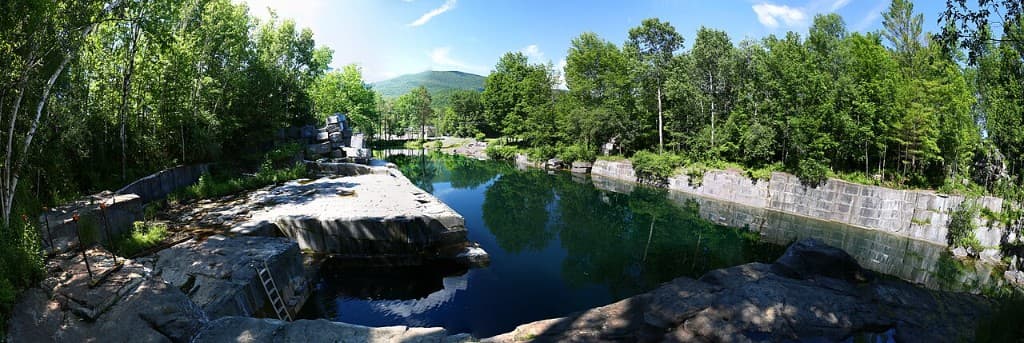
Flooded marble quarry with walls from 10 to about 30 feet on the higher edges. Center is 40+ feet deep. Edges are shallower; watch for shelves. The highest jumps are not the lowest-risk ones — the center is the more reliable landing. Open the Dorset Quarry guide.
3. Bolton Potholes — Bolton, Vermont
A series of round pools carved into the riverbed. Small to moderate jump heights (5–15 feet). Depths vary and are sensitive to flow year-to-year. Check current access restrictions before driving. Open the Bolton Potholes guide.
4. Emerald Pool — Chatham, New Hampshire
Evans Notch area. Jumps from 10 to 20 feet into a clear gorge pool. Access requires a trail; less crowded than Kancamagus stops because of that. Cold water year-round. Open the Emerald Pool guide.
5. Quechee Gorge Swimming Area — Quechee, Vermont
The jumps are from the covered bridge and the lower river access, not the high Route 4 bridge. High-bridge jumping is illegal and has killed people. Lower jumps from scouted edges are traditional but still serious. Open the Quechee Gorge Swimming Area guide.
6. Lower Ammonoosuc Falls — Carroll, New Hampshire
Pool below the falls with moderate jump heights. Classic White Mountains cold water. Open the Lower Ammonoosuc Falls guide.
7. Franconia Falls — Lincoln, New Hampshire
More of a slide-and-jump situation. Small heights, fast current in spring. Pool depths modest. More of a scenic add-on than a real jump destination. Open the Franconia Falls guide.
8. Bingham Falls — Stowe, Vermont
Jumps exist here but come with the most documented accident history in Vermont. Walls are slippery, water is cold, and the pool has variable submerged features. Scout aggressively or skip the jumps. Open the Bingham Falls guide.
9. Upper Ammonoosuc Falls — Carroll, New Hampshire
Smaller and less crowded than the Lower. Moderate jump heights into a classic cold pool. Open the Upper Ammonoosuc Falls guide.
10. Foster's Hole — Stowe, Vermont
Small gorge feature with moderate jumps. Local knowledge spot, not a big destination. Open the Foster's Hole guide.
11. Rattlesnake Pool — Stow, Maine
Short trail to a gorge pool with a modest cliff wall. Depth is reliable in summer. Worth the walk in. Open the Rattlesnake Pool guide.
12. Ashville Pond — Hopkinton, Rhode Island
Modest cliff features on the north shore. Good introduction-level jumping in southern New England. Open the Ashville Pond guide.
Where jumping is banned
Don't jump at:
- Bash Bish Falls (MA) — swimming entirely prohibited. 25+ documented deaths.
- Quechee Gorge high bridge (VT) — bridge jumping is illegal and has killed multiple jumpers.
- All Connecticut state park swim beaches — managed areas don't allow jumping.
- Most Massachusetts DCR-managed beaches — swim-only rules.
- Walden Pond — no jumping, and nearly everything else is banned too.
The scouting rules
Not optional. Not negotiable. Do these every time at every spot, including spots you've jumped before.
- Swim the pool first. Feet down, touch bottom. Know where the shallow shelves are.
- Identify submerged hazards. Rocks, logs, branches. They move in spring flood.
- Check the entry zone. Where you'll land. Not a general area — a specific spot.
- Go feet first, vertical, low. Not a cannonball, not a flip, not a gainer until you've done the feet-first version a dozen times at that exact spot.
- Watch someone else jump first if locals are there. They'll tell you things nobody writes down.
- Don't jump after a heavy rain. Water depth can change; debris can be hidden.
- Don't jump drunk. This is how most serious injuries happen.
- Never from a height you haven't scouted from underwater.
Depth-to-height guidelines
| Jump height | Minimum pool depth | Notes |
|---|---|---|
| 5–10 ft | 8 ft | Entry-level, still needs scouting |
| 10–15 ft | 10 ft | The traditional "safe" range |
| 15–20 ft | 12 ft | Getting serious; feet-first only |
| 20–25 ft | 14 ft | Experienced only, daylight only |
| 25–30 ft | 16+ ft | Expert territory, not a starter jump |
| 30+ ft | Don't | No swimming hole is worth it |
These are conservative planning guidelines, not guarantees. Real-world conditions change, and a pool that was deep enough last summer can be unsafe after spring floods, low water, or a shifted log.
A simple jump-day planning order
- Pick a spot with documented heights and a jumping tradition.
- Arrive early enough to scout before it's crowded.
- Swim and touch bottom before your first jump.
- Start at the lowest height at that spot.
- Work up only after multiple successful entries at lower heights.
- Stop jumping when you're tired, cold, or the light gets flat.
Before you go
- Cliff jumping is not a beginner swimming activity. Be a strong swimmer first.
- Cold water shock is real. Even in July, a 55°F gorge pool can put you in trouble in seconds.
- Always jump with someone else. Never solo.
- Phones on land. No pictures from the edge.
- If something looks different from last time, assume it's different.
Related guides
- Lesser-Known Summer Swimming Holes
- Best New England Lakes and Quarry Swims
- When New England Swimming Holes Warm Up
FAQ
Where is cliff jumping legal in New England?
Cliff jumping is generally tolerated at unmanaged swimming holes on public land (national forests, state forests, some town lands) but prohibited at most state parks and all managed swim beaches. Warren Falls, Dorset Quarry, Bolton Potholes, and Emerald Pool have long-standing jumping cultures. Bash Bish Falls and Quechee Gorge from the high bridge are explicitly prohibited.
What is the lowest-risk cliff jumping height?
The shortest one. There is no risk-free cliff jumping; there are only lower-risk choices. Jumps under 15 feet into personally scouted deep water with a clean vertical entry are the lower-risk category. Every foot above 20 feet increases impact force. Start at the lowest available jump on every new spot, every time.
How deep should the water be for cliff jumping?
A common conservative guideline is two feet of water depth for every foot of jump height, with a minimum of eight feet for any jump. A 15-foot jump needs at least 10 feet of water below the entry point. This assumes a vertical, feet-first entry. Bad entries need much more depth and can still cause serious injury.
Which New England cliff jumping spots have had fatalities?
Bingham Falls (VT), Bash Bish Falls (MA — where jumping is banned), Quechee Gorge (VT — high bridge, banned), and several unmanaged quarries have all had deaths. Warren Falls has had serious injuries. The pattern in almost every fatal case is a jumper going from a height they hadn't scouted from underwater first.
Should I jump into water I haven't scouted?
No. The single best safety practice is to swim the pool first, touch bottom where you plan to land, and verify the depth and the absence of submerged rocks or logs. A spot that was safe last year may not be safe this year if a log or boulder shifted in spring flood. Scout every time.
What's the most dangerous part of cliff jumping?
Not the height. Not the water temperature. The submerged hazard you can't see from above. Logs, rocks, and shallow shelves below the water line cause most of the serious injuries. Cold shock is a secondary risk that causes loss of function in the first 30 seconds.
View the next guide
Updated June 1, 2026. Pool depths change with water levels. Never jump from a height you have not scouted from underwater that same day.